
Sask. woman awaits seizure as province's first robotic epilepsy surgery patient
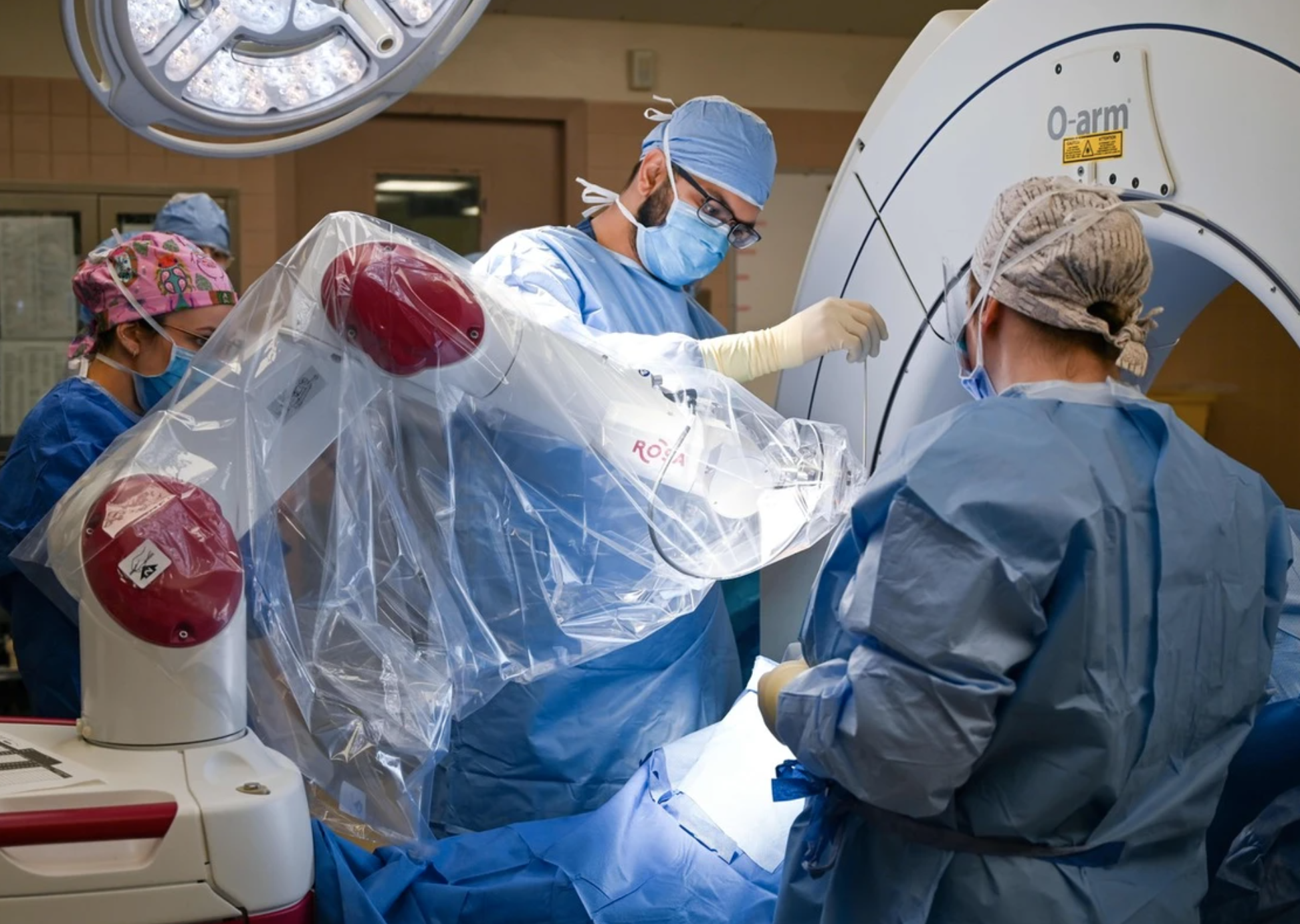
With ten tiny flexible electrodes inside her skull, Jacky Willmek is tethered to the wall at Saskatoon’s Royal University Hospital, waiting to have a seizure so a computer can precisely map out its location in her brain.
The longtime Saskatoon resident and pharmacy assistant lives with epilepsy that cannot be cured with medication. She is the first person in the province to have a surgery performed by a neurosurgical robot that can place electrodes about as thick as a small blade of grass in the brain to determine where seizures are coming from.
For patients like Willmek (nearly 4,000 people in Saskatchewan live with drug-resistant epilepsy), the minimally-invasive procedure, which takes about an hour and a half in the operating room, is the mini-surgery that could enable a bigger one to cure the condition.
More than two weeks out from the robotic surgery, with wires coming out of the left side of her head, Willmek is playing a waiting game (And, she says, consuming quite a bit of Netflix).
“I feel like I’m somehow putting some pressure on myself, like I need to have a seizure, even though I’m very aware I have no control over that,” she said in a phone interview with the StarPhoenix.
“I wish I did. If only I could make myself.”
Willmek says the upside is that the important people in her life are nearby. She and her doctor discussed moving her case to Calgary, but the technology launching at RUH, with the help of a $1.2M campaign in 2025, offered a similar timeline.
“It’s pretty exciting, because then I can actually have people come visit me. Like, I’ve had somebody here every day,” the 35-year-old said.
Robot allows for ‘bull’s-eye’ precision
The fact that Willmek’s surgical team thinks her seizures are consistently coming from just one part of her brain (the left temporal lobe) made her a great candidate as the robotic system’s first patient.
Willmek’s neurosurgeon, Dr. Amit Persad, compares the technology to a guarantee of hitting the bull’s-eye when inserting the electrodes into the brain.
“You can think of the electrodes as being bullets, like we’ve got to put bullets into the exact right spot … With the robot, it puts us at the exact right angle and distance that we can just hit bull’s-eye every time,” he said.
“Putting these electrodes in manually, without the robot, is at least twice as inaccurate, based on studies that we have available.”
The result, says Persad, is inferior imaging data and increased safety risks for the patient.
Thus, relying on the robot is the standard of care for those in RUH’s seizure investigation unit, and Saskatoon is in the “middle of the pack” among Canadian cities in adopting it, he said.
Once inside the brain, the electrodes, which resemble bendable millimetre-thin wires with about ten contact points each, collect data to record brain activity, said Dr. Alexandra Carter, the director of the Saskatchewan Epilepsy Program.
“So we can aim those electrodes to get the most important areas,” she explained. ” … And then that lets us build that 3D map.”
Carter says the first few seconds of a patient’s seizure — which often feel like déjà vu or nausea — can provide the most valuable information for determining the source.
“Those first parts that happen are actually the most important points for us, because those give us the most information about where we think the seizures are coming from, and so then that’s where we’re trying to record.”
With that clear map of where a seizure begins, the door is opened for surgery to remove the small, specific part of the brain. Persad says this procedure is often performed with the patient awake to ensure key functions, like speech, aren’t lost.
“When epilepsy comes from one part of the brain, if it’s safe to remove, then doing surgery to remove that part of the brain can cure the epilepsy altogether.
“Not in every case, but in many cases,” he said.
Willmek had her first seizure in February 2022. While on medication and managing lifestyle triggers, she still has seizures about once a month.
She says she’s “a bit shocked” to be the robot’s first patient. She’s conscious that others who live with drug-resistant epilepsy face more frequent seizures, but is grateful that the specifics of her case met the criteria to have the procedure.
As for considering the next surgery — contingent on the robot’s findings — Willmek says she’s just trying to focus on staying present.
“I have really been trying not to get too far ahead of myself on that,” she said.
“That’s why I’m here … to find out what would be the safest, and proper, best outcome route to take.”