
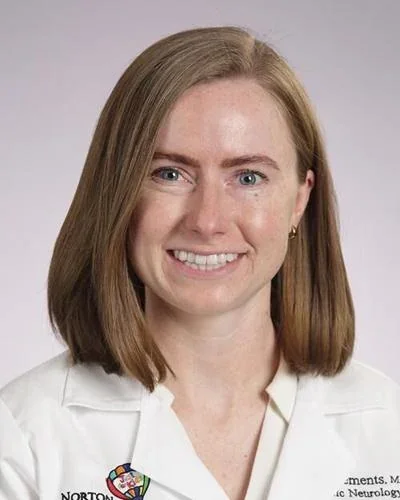
Dr. Marie Clements is an epileptologist with Norton Children's Neuroscience Institute.
November is National Epilepsy Awareness Month, and as the neurological condition is one of the most common for children, an epileptologist with Norton Children's Neuroscience Institute shared some signs parents should watch for.
According to Dr. Marie Clements, about 1-2% of children have epilepsy. "It sounds like a small number, but it's one of the most common neurologic problems with children," she said.
"Epilepsy just means someone has had more than one seizure," Clements explained. "Essentially, a seizure is a sudden onset of abnormal electrical activity in the brain that can cause a variety of different symptoms and interrupt the brain's normal function."
Clements said that seizures can look different depending on where in the brain they begin. "I think a lot of people tend to picture what you see in the movies, like full body shaking and stiffening, and something really scary," she said. "And seizures can look that way, but seizures can actually look a few different ways."
"When we think of those full body shaking and stiffening seizures, those are those pulses of electrical activity going throughout the brain that are causing the muscles to jerk," she continued. "However, if a seizure starts, for example, in the part of the brain that controls vision, it could form some sort of visual phenomenon. Like, I have some patients who see certain colorful lights with their seizures, or patients might smell a certain smell at the beginning of their seizures."
However, while seizures may look different depending on where in the brain they start, Clements said that individuals tend to have the same type of seizure every time.
"For example, if a child is noticing something that's the same every time or very repetitive, we call it stereotyped — like a strange feeling in their hand that keeps happening if their seizures are starting in a certain part of the brain that controls their hand," Clements said.
"That part is really important when parents are looking out for something," Clements continued. "It's not usually that one day it's this, the next day it's that. It's usually something very consistent. Parents can take a video of anything they are worried about or think is unusual — that can be so valuable to a neurologist."
Clements emphasized the importance of knowing how to respond to a seizure, no matter the affected individual's age. "The principles are pretty basic," she said. "If you notice someone having a seizure, turn them on their side. Don't put anything in their mouth. There's old wives' tales about holding down their tongue — the tongue is well attached, people are not going to swallow their tongue, so don't put anything in their mouth. See how long the seizure lasts."
"Many individuals with epilepsy may have an emergency medicine on them or with their parent that can be administered if the seizure goes on beyond a few minutes to help stop the seizure," she added.
Clements noted that people can also respond differently to the immediate aftermaths of seizures. "For some types of seizures, people can go right back to doing what they were doing," she said. "But for other types, sometimes people will be a little bit confused or sleepy, may take a nap, just because their brain is tired from having that electrical activity firing, so those can be signs to look out for too."
According to Clements, there are three common treatment options for children with epilepsy: medicine, diet and surgery.
"Usually, the first way is via medicine. In general, [for] about half of patients, their seizures go away completely with the very first medicine we try," Clements said. "[For] another 20% or so, their seizures go away with the second medicine we try. But that leaves about a third of our patients who have tried two medicines and are still having seizures."
The next option is usually a specific diet. "The diet that has good evidence for children with epilepsy is called a ketogenic diet. It's a high-fat, adequate protein, low-carbohydrate diet that can help manage seizures," Clements explained.
According to Clements, surgery depends on the part of the brain the abnormal electrical activity is occurring in. "In general, the goal with an epilepsy surgery is to figure out where exactly in the brain are the seizures coming from," she said. "We do some tests, an EEG or a brain wave test, where we catch seizures, see where in the brain they're starting. We do a really detailed MRI picture of the brain to see if we see any clues of areas that look structurally different that could be generating seizures. So, we do several imaging tests to try to figure out where in the brain are seizures starting, to figure out is that a part of the brain that could be removed or damaged with a laser to make the seizures go away."
"Whereas medicines tend to treat epilepsy, sometimes surgeries could actually cure epilepsy by removing the part of the brain that is generating seizures," Clements noted.
However, Clements added that some children may also outgrow their epilepsy. "In adults, usually epilepsy tends to be lifelong. If seizures start in adulthood, usually someone needs medicine for life," she explained. "It's very different in children, where often if children start having seizures at a young age — as an infant or toddler, or even early school age — there is a decent chance, depending on what type of epilepsy it is, that they could outgrow their seizures by early adolescence or their teenage years."
If a parent is concerned their child may have epilepsy, Clements recommended taking a proactive approach. "Start by talking with the pediatrician, letting them know what the concerns are, and they can place a referral to pediatric neurology to evaluate further," she said.